Amsterdam, 11 juli 2007 – De Verenigde Staten bieden IT-bedrijven de meest aantrekkelijke omgeving om zich te vestigen, zo blijkt uit onderzoek van de Economist Intelligence Unit. Nederland neemt wereldwijd de twaalfde plaats in van meest aantrekkelijke IT-landen.
Het onderzoek van de Economist Intelligence Unit, gesponsord door de Business Software Alliance, onderzocht de aanwezigheid van belangrijke factoren zoals de kennis en expertise in een land, de innovatievriendelijkheid van de cultuur, de kwaliteit van de technologie-infrastructuur, de stevigheid van het juridische raamwerk en de wel of niet uitgebalanceerde overheidsteun.
Het volledige Engelstalige persbericht vindt u hieronder.
Noot voor de redactie, niet voor publicatie:
Voor meer informatie of digitaal beeldmateriaal:
Lammers van Toorenburg Benelux PR
Sabine Lakerveld, Marjan Kok
Telefoon: 030 – 65 65 070
E-mail:
bsa@lvtpr.nl ###
The US and Japan provide the strongest environments for IT competitiveness, finds the Economist Intelligence Unit
Relatively few countries possess all the factors necessary to support a thriving information technology sector, but the United States, Japan, South Korea and the United Kingdom provide the strongest environments for IT competitiveness, a new study concludes.
As reflected in the Economist Intelligence Unit's "IT industry competitiveness index", these factors include an ample supply of skills, an innovation-friendly culture, world-class technology infrastructure, a robust legal regime and well-balanced government support, not to mention a competition-friendly business environment. Those countries possessing most of these “competitiveness enablers” are also home to high-performance IT industries: all but four of the top 22 countries in the Economist Intelligence Unit index are also among the world's top countries in terms of IT labour productivity.
On the strength of its unique combination of scale and quality in the key areas that promote IT competitiveness, the US tops the index table. Asia-Pacific countries are well-represented, with Japan, South Korea and Australia among the top five index performers, and the UK heads the ranks of European countries, closely followed by Sweden and Denmark. All, however, face stark challenges in the effort to remain competitive: chief among them are ensuring a steady supply of talent for the industry, and securing the right level of support from government to promote competition and innovation.
These are among the major conclusions of a new study, The means to compete: Benchmarking IT industry competitiveness, written by the Economist Intelligence Unit and sponsored by the Business Software Alliance. The index and report are the first attempt to compare countries' performance in building an environment for IT industry competitiveness; 64 countries are covered across seven regions.
Other key findings of the research including the following:
Few nations’ IT sectors can compensate for major environmental weaknesses. India and China have been able to parlay unique factors, such as workforce size, low wages or language attributes, into strong sector performance, compensating for glaring weaknesses in the business environment. Few other countries will be able to manage this feat. Moreover, India and China will need to improve on their enablers, as their cost advantages will erode.
Skills requirements are changing radically. Talented IT employees are in short supply everywhere, but the situation will get tougher, as the nature of skills needed is changing. In addition to technical knowledge, tomorrow’s IT employee will require expertise in project management, change management and business analysis, among other areas. Educational systems in only a few countries have made a firm start to adjust their training curriculums.
Skills-rich emerging markets are likely to move up the index table. Future rivalry to India and China will come from the likes of Russia, Brazil, Malaysia and Vietnam, as well as smaller nations such as Estonia, Lithuania and Chile. Most perform respectably in at least one aspect of IT competitiveness, and the skills base of each is improving. Carving niches in software development and services represents their best chance of moving up the table.
The legal regime is an important differentiator. Countries must balance open competition in IT with robust protection for intellectual property rights. The US and western Europe—thanks partly to the galvanising efforts of the European Union—stand heads above the rest in the degree of protection afforded and in enforcement. A vigorous IPR regime is not incompatible with an “open approach” to innovation in IT.
Eager governments must strike the right balance. Governments can do much to help create an environment in which IT firms will thrive, but it is a delicate balancing act. Through far-sighted policy, governments can help improve competitiveness. At the same time, they must avoid picking winners, among either IT firms or technologies. West European governments have been the most successful in striking the right balance.
"There is a strong link between the presence of IT industry competitiveness enablers in countries and the strength of their IT sector," confirms Denis McCauley, Director, Global Technology Research with the Economist Intelligence Unit. "Governments and industry leaders must pay close attention to these enablers if they wish to boost the global competitiveness of their IT industries."
“More and more, information technology is a leading driver of economic and social progress worldwide,” says Robert Holleyman, president and CEO of the Business Software Alliance. “These findings can serve as a roadmap for governments to capitalise on those factors which can strengthen their IT sectors and accelerate the benefits a thriving IT industry can deliver to the entire society.”
IT industry competitiveness index, 2007
Overall scores and ranks 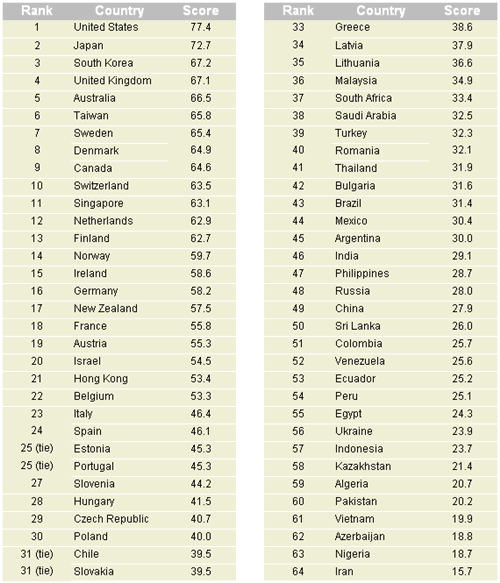
Countries are scored on a scale of 1 to 100.
Source: Economist Intelligence Unit, 2007.
Editors' note
Methodology: How the scores were derived
The IT industry competitiveness index is organised into six distinct categories of quantitative and qualitative indicators, numbering 25 in all. The category and indicator weights were formulated by the Economist Intelligence Unit's modelling team using, as a guide, individual correlation coefficients of each indicator against a measure of IT labour productivity. The result is an overall index score and category scores for each country. The categories and their weights are: overall business environment (10%), IT infrastructure (20%), human capital (20%), legal environment (10%), R&D environment (25%) and support for IT industry development (15%).
Qualitative indicators are scored by Economist Intelligence Unit analysts according to specific scoring criteria. Quantitative indicators are normalised through the population set so that each country is measured from 0 to 1 by applying a formula to each data point. Each indicator is then converted into a score of 0-100. The composite score for each country is also based on an index range of 0 to 100, with 100 representing the highest and best possible score. The data used in the rankings are sourced from the Economist Intelligence Unit, the United Nations, the World Bank, the World Industrial Property Organization, IDC, Pyramid Research and other organisations. For more information on the methodology, please refer to our white paper.
The means to compete: Benchmarking IT industry competitiveness
is available free of charge at
www.eiu.com/mtc or
www.bsa.org/eiu About the Economist Intelligence Unit
The Economist Intelligence Unit is the business information arm of The Economist Group, publisher of The Economist. Through our global network of over 650 analysts, we continuously assess and forecast political, economic and business conditions in 200 countries. As the world's leading provider of country intelligence, we help executives make better business decisions by providing timely, reliable and impartial analysis on worldwide market trends and business strategies.
About the Business Software Alliance
The Business Software Alliance (
www.bsa.org) is the foremost organization dedicated to promoting a safe and legal digital world. BSA is the voice of the world's commercial software industry and its hardware partners before governments and in the international marketplace. Its members represent one of the fastest growing industries in the world. BSA programs foster technology innovation through education and policy initiatives that promote copyright protection, cyber security, trade and e-commerce.